
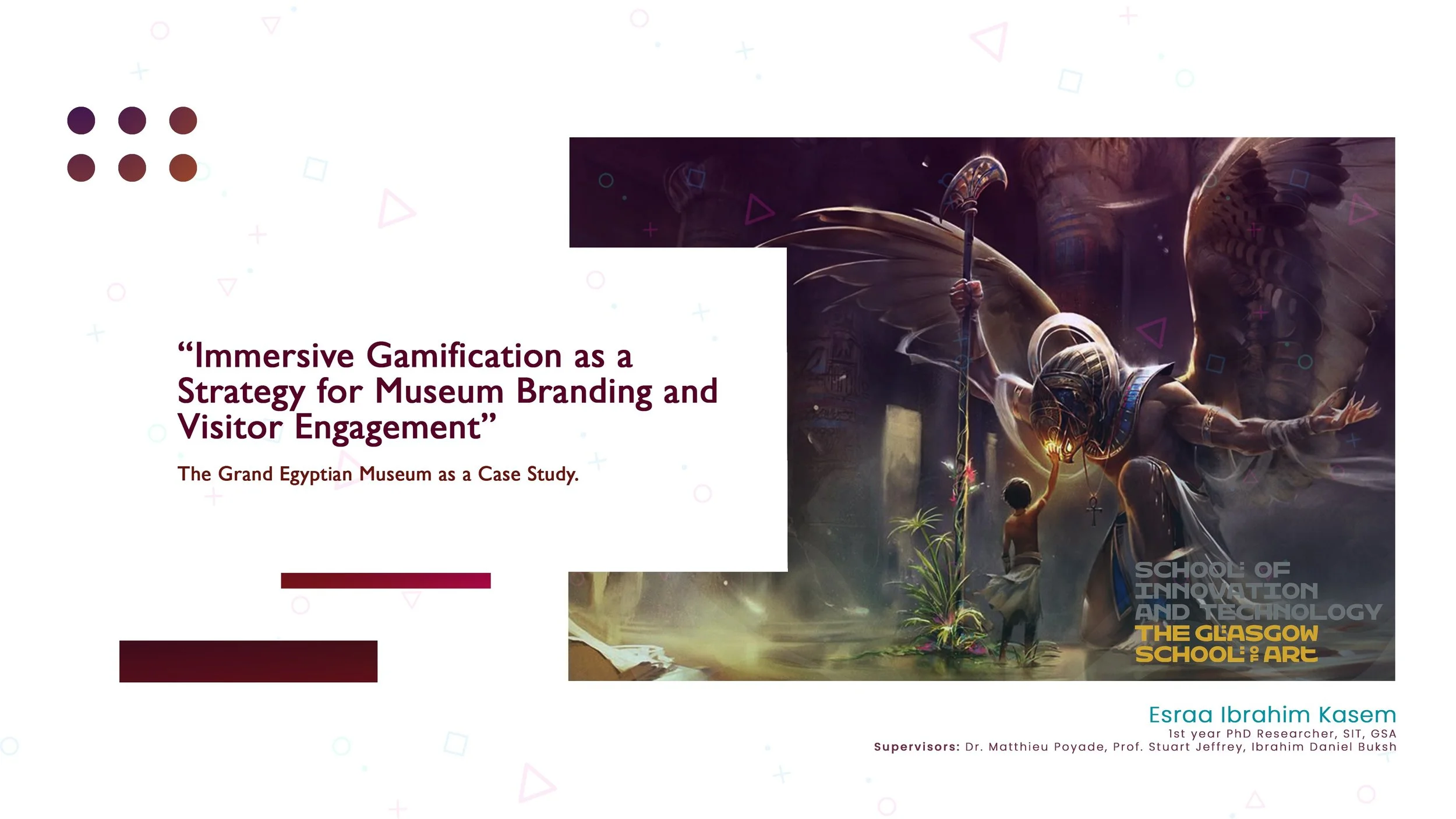
ESRAA KASEM: IMMERSIVE GAMIFICATION AS A STRATEGY FOR MUSEUM BRANDING AND VISITOR ENGAGEMENT
THURSDAY 23 JULY, 14:00 - 14:25
Johnson Auditorium
The convergence of gaming technologies, Extended Reality (XR), and metaverse platforms has fundamentally reshaped contemporary brand communication, opening new possibilities for cultural institutions to engage audiences beyond traditional exhibition formats.
This research examines how immersive gamification, the strategic application of game design elements such as points, badges, challenges, avatars, and interactive narratives, can be leveraged as a museum branding and visitor engagement strategy, using the Grand Egyptian Museum as an emerging case study within this evolving landscape.
Gamification has long demonstrated its capacity to enhance motivation, emotional attachment, and brand loyalty by transforming passive audiences into active participants. Within digital game advertising, frameworks such as in-game advertising (IGA), advergames, and around-game advertising illustrate varying degrees of brand integration, ranging from subtle product placement to fully immersive, brand-centred environments.
These typologies offer a transferable model for museums seeking to embed cultural content within interactive, game-like experiences rather than relying solely on conventional, static displays.
Central to this inquiry is the role of Extended Reality, encompassing Virtual Reality, Augmented Reality, and Mixed Reality, as a spectrum of immersive technologies capable of dissolving boundaries between physical and digital heritage spaces.
Drawing on multisensory design principles, this presentation explores how visual, auditory, and haptic modalities converge to produce psychological states of immersion, presence, and flow, each of which has been empirically linked to stronger brand recall, emotional engagement, and memorable visitor experiences.
The discussion further situates museum branding within the broader metaverse ecosystem, where platforms such as Fortnite and Roblox have demonstrated the commercial and cultural potential of branded virtual worlds, from NIKELAND to TIME's "March Through Time," a notable precedent for digital heritage representation within gamified environments.
These cases illustrate how avatar embodiment, social co-presence, and participatory storytelling generate what scholars describe as "WORLDNESS": an affective sense of belonging to a living, persistent world rather than a transactional encounter. For museums, this reframes branding from a one-directional communication strategy into a relational, co-created experience, where visitors, as prosumers, actively shape and circulate cultural meaning within and beyond the institution's physical walls.
Despite the rapid growth of immersive technologies and gamified marketing strategies, existing research reveals a significant gap in their application to cultural heritage contexts, particularly concerning long-term engagement and the translation of experiential marketing principles into museum practice. This research argues that the Grand Egyptian Museum represents a timely and strategically significant site for exploring how virtual in-game events, XR technologies, and gamification frameworks can be synthesised into standards for designing positive, brand-enhancing visitor experiences.
By bridging digital game advertising theory, experiential marketing principles, immersive technologies and emerging branding practices, this research contributes a conceptual framework for understanding how museums might harness immersive gamification not as a peripheral novelty, but as a core strategic tool for cultural identity-building, audience engagement, and the future of heritage communication in increasingly virtual and participatory digital environments.